
Showing posts with label Orchard. Show all posts
Showing posts with label Orchard. Show all posts
Saturday, 25 July 2015
Flowers in the orchard
The most success I've had with planting plug plants in the meadow area of the orchard - and the one most popular with the bees - has been with tufted vetch. Also flowering this month is the much-maligned ragwort, clover, buttercups, rosebay willowherb and self-heal. The long grass also gives shelter to numerous other invertebrates, frogs and hedgehogs.


Saturday, 27 June 2015
In the orchard
Looks like I'll be in for a bumper crop from the top fruit this year: apples, pears, plums and cherries all looking good. I've managed the grass a little differently this year - still leaving most of it long but cutting it until mid May so it doesn't grow quite so long and thick, but plenty long enough for the wildlife to benefit from. As far as flowers for the meadow go I've planted some hardy geranium "Johnson's Blue" in there - it's a good plant for the pollinators and vigorous enough to compete with the grass. The ox-eye daisies which I put in as plug plants a few years ago have all but disappeared - I've since found out that it's a pioneer plant and that's how it behaves. You live and learn. The other plugs I put in were some vetches and they're thriving. The red campion which I put in as seed still keeps doing it's thing. Other than that there's what was there all along - a profusion of dandelions which in the spring are a useful source of nectar when there's not much else flowering and now clover, buttercups and self-heal. And there's more than enough flowers in the garden, it's the long grass which is so good for the wildlife.

The other pleasure in June is the flowering of the elderberry trees and dog roses, especially the one which has climbed into my plum tree:

Most modern garden roses are hopeless for pollinators but any of the wild or open-centred single flower types are great.


The other pleasure in June is the flowering of the elderberry trees and dog roses, especially the one which has climbed into my plum tree:

Most modern garden roses are hopeless for pollinators but any of the wild or open-centred single flower types are great.

Saturday, 31 August 2013
Habitat

It's all very well having all these plants for pollinators but they also need places to live and breed. The top of my plot behind the trees is where I chuck all my rammel - prunings, bits of wood, piles of bricks, slabs, bits of junk that might come in handy. It might look like a tip - actually it is a tip - but to the bees it's home sweet home. No need for silly "bee hotels" and the like if you've got a tip.
For the caterpillars of our colourful garden butterflies like peacocks, small tortoiseshells and red admirals only one plant really matters - the stinging nettle. I've got several patches around the edges of my plot (especially in the tip) and it's always fascinating to watch the caterpillars munching their way through them.
The grassland species like meadow browns, gatekeepers and ringlets depend on - no surprise - grass. The grass needs to left long until the end of the season; in my orchard I leave it until the fruit is ready to be picked. I strimmed it down under my plum tree a couple of weeks ago and under the apple trees today. I'll leave the rest of it until the end of autumn as there's quite a few wild flowers in there too - flowering at the moment is ragwort, tufted vetch, field bindweed and knapweed. And since I've been leaving the grass long I've noted two new species here - the large skipper and small copper.
So there you go - habitat for bees and butterflies: a tip, nettles and long grass. Hardly surprising that urban allotments are so rich in wildlife.


So there you go - habitat for bees and butterflies: a tip, nettles and long grass. Hardly surprising that urban allotments are so rich in wildlife.

Cinnabar moth caterpillar on ragwort.

Small tortoiseshell caterpillars on stinging nettle.

Small copper.
Sunday, 30 September 2012
Meadow grass management
I've cut back the meadow grass in the orchard so it looks much bigger all of a sudden. I'll keep it short now so that the finer grasses and wildflowers can get off to a good start next spring. I'm also planning to scarify some areas and sow some yellow rattle.

Saturday, 30 June 2012
Pretty as a picture
Harvesting broad beans, cabbage, peas, carrots, lettuce and wild rocket from the plot. I've taken up the garlic too for drying. Lovely time of year despite the rain. I especially like seeing the dog roses and elderflowers in the hedgerows in June.


The orchard was looking a bit battered in the wind and rain the other day...

...and I appreciate the beauty of the long grasses more and more, it's a mystery me why people would want to buy the non-native ornamental ones from nurseries, though that's another story.

Lots of bees buzzing around when the sun comes out and many other beasties besides. I've no idea what this is on the phacelia but he seems to be enjoying himself:

And the hoverflies are pretty stunning:

All in all pretty as a picture, if I do say so myself.
Wild flowers
One effect of the weird weather this year is that the pictorial meadow seeds I sowed back in April totally failed to germinate. Not a sausage. They're not cheap either. The previous couple of years they've come up a treat and been a big hit with the bees. All I've got to show this year are a few shirley poppies that self-seeded from last year and a few opium poppies which always come up everywhere anyway. And a stray foxglove.

Incidently the yellow one in front is a cerinthe which found it's way in there somehow. So anyway I've plugged the gap with some Nicotiana mutabilis that I've been growing so hopefully I'll have something to show for it by the end of summer, that's if the slugs haven't completely ravaged them by then which they seem intent on doing at the moment.
At the other end of the plot by the horseradish the cornfield mix is doing better. No need to sow this again, it's happily self-seeded from last year with the usual mix of corncockles, field poppies and corn marigolds; the purple one at the bottom left is the perennial Phacelia bolanderi, another plant that's popular with the bees:

I've also been growing a few flowers to add to the ox-eye daisies in the orchard. A couple of weeks ago I planted out some tufted vetch - which had only reached the size of small plugs so are struggling a bit - this week it's the turn of some potentilla which I've grown using some saved seed from my back garden. Before you say anything I know they're not a wild flower and they won't come true from seed either but it hardly matters. And besides, I stole the idea after reading about how someone had done it in Gardens Illustrated, and if it's good enough for them then it's good enough for me.
I know I know this should be done in autumn but the ground is sodden at the moment and the plants are fairly beefy so I reckon they'll be right.

Sunday, 3 June 2012
Grass management for wildlife
There's a lot of talk these days about the desirability of having "meadow areas" in gardens to replace those lost to intensive agriculture in the countryside. This is a bit of a misnomer as a meadow is a field of grass and wildflowers that's cut for hay in summer before being grazed by stock, something which clearly doesn't happen in gardens. But if the gardening media wants to rebrand an area of weedy long grass as a wildflower meadow then that's fine by me.
As has been pointed out by Dr Ken Thompson, it's actually the long grass that is of more use to a greater diversity of wildlife than the flowers, although people seem to have a natural affinity with wild flowers and who can blame them.
Having checked out the research (alright reading a couple of books) my own approach with the grass in my orchard is to mow a couple of paths through it then cut a section of it at the beginning of June, some more at the beginning of July, then all of it at the end of summer and keep it all short from then on going into winter. Hopefully this provides the right mix of long and new short grass for the needs of the greatest variety of invertebrates. Of course I can't resist wildflowers either, many of which, like the clover, buttercups, self-heal, and wood forget-me-not need no encouragement from me as they were already there, and they are obviously of use to pollinating insects. To these I've added ox-eye daisies and bladder campion raised from seed and also sown pink campion. This year I've got some tufted vetch, field scabious and vipers bugloss on the go in the coldframe which I'll plant out later.


Ox-eye daisies

Pink campion
Saturday, 16 July 2011


Saturday, 2 July 2011
Gardening for wildlife
I've always gardened with wildlife in mind, and each year try to add something new for the benefit of my fellow creatures.
When I first took over this plot twelve years ago it had been vacant for some years and was fast returning to the how nature intended - brambles and young ash seedlings were making the beginnings of primary temperate rainforest. So I can't take the credit for the hedges around two sides of my boundary which in places are thickets of blackberry and dog roses up to three or four metres deep. Together with the trees - elder, hawthorn, holly, horse chestnut and ash - they make good cover for the birds for nesting and feeding. I see and hear all of the common garden birds as well as the endangered song thrush which nests here up in the tangle of dog roses. I leave any fallen or standing dead wood to decay in it's own sweet time and add piles of logs and brash as homes for hedgehogs and any other creatures which see fit to use them. The foxes lurk about here too; they make a nuisance of themselves scratting about in my crops from time to time but no doubt they were here long before I was. At this time of year much of the whole is smothered by the twining stems of bindweed, whose pure white flowers are enjoyed by night-flying moths. Wildflowers such as rosebay willowherb, thistles and mallow add to the jolly melee. Not forgetting the nettles which are so important for the butterflies and their caterpillars. To all this I've added hawthorn, rowan, amelanchier and cherry plum.


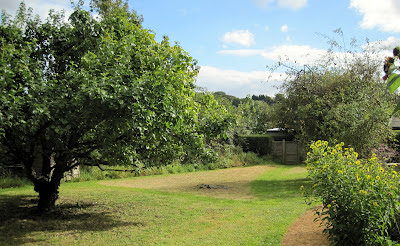
The trees and hedgerow merge into the grasses and flowers of the orchard, mimicking the features of a woodland edge (the ecotone, to use the scientific parlance). Since planting out the ox-eye daisies in the orchard I've left most of the grass to grow long with just a couple of paths mown through - many butterfly caterpillars rely on grass species to feed on before emerging as adults in July and August. Some parts of the orchard are shady and others open - one area in particular I had to take out some plum tree suckers which were taking too much light from the growing areas and I now like to think of this area as my sunny glade. Since I've stopped mowing the grasses and wildflowers that were already there have been able to reach their full potential - amongst them self-heal, buttercup and clover - all much appreciated by the bees and butterflies.


In the growing areas the meadow and cornfield mixtures which I sowed last year have spread themselves around a little further and I've added to them here and there. These together with the green manure plants that I've left to flower are buzzing with bees throughout the day, and it's where I always start mine. I'm also slowly adding to my collection of beneficial herbaceous perennials to provide as much pollen and nectar throughout the year.


For as long as anyone can remember this area has also been a magnet for migrating swifts who make their nests under the eaves of the old tape factory just over the road. And there's also the bats fluttering around at dusk - I've no idea where they roost but they must enjoy the profusion of night-flying moths.
All in all it makes life worth living.
And then some.
Subscribe to:
Posts (Atom)