Saturday, 16 July 2011

Back garden in July

Scabious

Kniphofia

Clematis and perennial sweet pea

Potentilla

And the rest:

Saturday, 2 July 2011

Gardening for wildlife

I've always gardened with wildlife in mind, and each year try to add something new for the benefit of my fellow creatures.

When I first took over this plot twelve years ago it had been vacant for some years and was fast returning to the how nature intended - brambles and young ash seedlings were making the beginnings of primary temperate rainforest. So I can't take the credit for the hedges around two sides of my boundary which in places are thickets of blackberry and dog roses up to three or four metres deep. Together with the trees - elder, hawthorn, holly, horse chestnut and ash - they make good cover for the birds for nesting and feeding. I see and hear all of the common garden birds as well as the endangered song thrush which nests here up in the tangle of dog roses. I leave any fallen or standing dead wood to decay in it's own sweet time and add piles of logs and brash as homes for hedgehogs and any other creatures which see fit to use them. The foxes lurk about here too; they make a nuisance of themselves scratting about in my crops from time to time but no doubt they were here long before I was. At this time of year much of the whole is smothered by the twining stems of bindweed, whose pure white flowers are enjoyed by night-flying moths. Wildflowers such as rosebay willowherb, thistles and mallow add to the jolly melee. Not forgetting the nettles which are so important for the butterflies and their caterpillars. To all this I've added hawthorn, rowan, amelanchier and cherry plum.


The trees and hedgerow merge into the grasses and flowers of the orchard, mimicking the features of a woodland edge (the ecotone, to use the scientific parlance). Since planting out the ox-eye daisies in the orchard I've left most of the grass to grow long with just a couple of paths mown through - many butterfly caterpillars rely on grass species to feed on before emerging as adults in July and August. Some parts of the orchard are shady and others open - one area in particular I had to take out some plum tree suckers which were taking too much light from the growing areas and I now like to think of this area as my sunny glade. Since I've stopped mowing the grasses and wildflowers that were already there have been able to reach their full potential - amongst them self-heal, buttercup and clover - all much appreciated by the bees and butterflies.


In the growing areas the meadow and cornfield mixtures which I sowed last year have spread themselves around a little further and I've added to them here and there. These together with the green manure plants that I've left to flower are buzzing with bees throughout the day, and it's where I always start mine. I'm also slowly adding to my collection of beneficial herbaceous perennials to provide as much pollen and nectar throughout the year.


For as long as anyone can remember this area has also been a magnet for migrating swifts who make their nests under the eaves of the old tape factory just over the road. And there's also the bats fluttering around at dusk - I've no idea where they roost but they must enjoy the profusion of night-flying moths.

All in all it makes life worth living.

And then some.

Saturday, 18 June 2011

Better than a poke in the eye

We had one good day of rain last weekend and although we could do with much more it was better than nothing, which is where we were. A few showers in the week and some heavy ones today; nothing special but better than a poke in the eye.

Cropping strawberries and raspberries, spring cabbage, early carrots, potatoes and peas, broad beans, green garlic, salad leaves and herbs.

Onwards and upwards

I've been enjoying the Early Onward peas although of course the crop isn't as hefty as usual due to the lack of rain. They've got plenty of compost under them and I've been watering since they started flowering.

The Onward maincrop were sulking until we had last weekend's rain since when they've put on a spurt. I've another row following them on too.


Roots

The scorenza is nicely established but the carrots and leeks are struggling. Still, they've plenty of time in the ground yet and with a bit of luck we might get a wet summer.

I start my early carrots off in a trough in the greenhouse in March and move them outside as it starts warming up and am cropping the babies now.


Spuds

These have really suffered the lack of rain. I've tried a few of the earlies for a treat even though they're still immature - it's got to be better than paying for imported new potatoes. Not surprisingly the lack of rain has led to the maincrop flowering early, how much of a crop I'll get is anyone's guess but I'm not holding my breath.

Brassicas

I gave the ropey looking summer cabbage I was going to pull out a reprieve - just as well as it's managed to shake off the attention of the flea beetles and grow away nicely. The sprouts and broccoli are doing alright too.

I'm still eating spring cabbage, it's nearly over but has kept me in greens for weeks now; I've some kale to fill the gap before the summer ones are ready.


Soft fruit

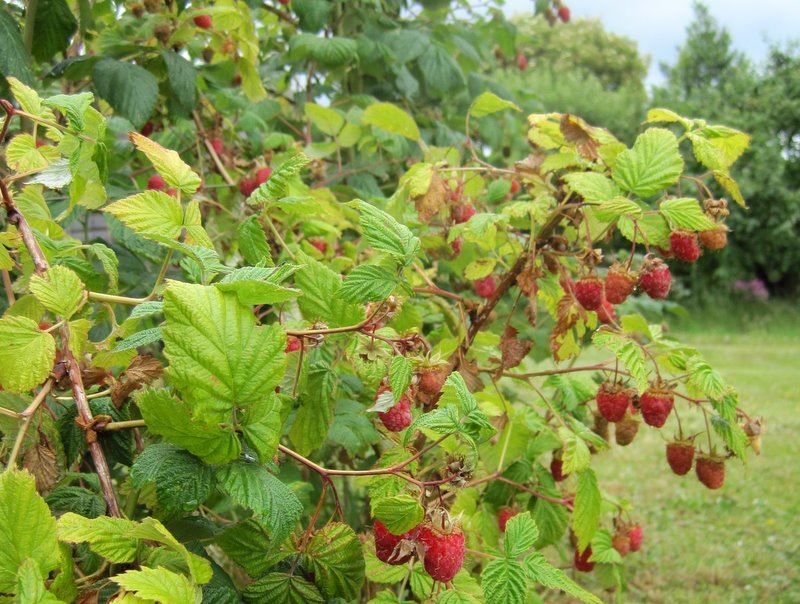
My old strawberry and raspberry plants have been the star performers this year - all that early warmth has resulted in the biggest and sweetest fruits I've ever known. The gooseberries are later than usual but worth waiting for.


Food for the soul

I used to grow flowers for cutting and drying, now I grow them for the bees and butterflies. Phacelia, poppies, campion and more are all flowering now. The bees are loving them and so am I. Some I've sown this year but more than a few are self-sown from last year. And some are happy accidents - like the winter tares I sowed for green manure then left to flower.

It's good to see the RHS doing their bit with its Perfect for Pollinators scheme and that Sarah Raven is catching up with my ideas.

I'm nothing if not modest.


Saturday, 4 June 2011

Trentham Gardens

Now that most of the sowing and planting is done I've time to slope off and visit some gardens. So today I headed off up the A50 to Trentham Gardens near Stoke, which are described by Alan Titchmarsh as one of the UK's must-see gardens. Blimey. They've had some serious money spent on them in recent years so I had high hopes.

The Trentham estate has an interesting history - it was once the country pile of the Duke of Sutherland, who had the house demolished in 1911, one reason being the smell of industrial pollution from the nearby River Trent, which I for one find hilarious. The Gardens were also the site of the infamous Trentham Ballroom (1931-2002) which hosted all the best bands from The Beatles to Pink Floyd. The parkland and lake were laid out by Capability Brown and the original Italianate gardens by Sir Charles Barry in the 18th and 19th centuries. It is now owned by St Modwen Properties PLC and Willi Reitz, the German entrepreneur, and operated as a "leisure destination". I went anyway.

The entrance to the gardens is through the horrendous "shopping village" which doesn't exactly put you in the right frame of mind for what is to come.

The first garden is the Piet Oudolf-designed Rivers of Grass, which is how it sounds. I wasn't impressed at first but when I went back later I started to get my head round it. It probably looks better in autumn. This leads on to the Floral Labyrinth, which apparently looks better in July and August, which might explain why they haven't bothered getting on top of the weeding yet.


The 19th century Italian Gardens were given a complete makeover in 2004 by designer Tom Stuart-Smith "with one of the largest contemporary perennial plantings in Europe". Phew. Some lovely planting combinations I must admit and the area I spent the most time in. What's more I'd timed it right to see the collection of bearded irises.


At the bottom of the gardens by the lake there's a statue of Perseus and Medusa - God knows what that's all about, maybe put there to scare the kiddies, and unmistakably a fine example of the mindset of the 19th century aristocracy.


I suppose the only problem with big public gardens like these is that they don't seem to have any soul. "We've spent all the money on the designers chaps, now here's the maintenance schedule - get on with it." Undoubtedly beautiful in parts, but where's the love? Where's the passion? It's just in the way of things I suppose.

The little show gardens - "for garden inspiration on a domestic scale" - were quite interesting, something for everyone, nice for the kiddies too - just as well after that statue.

I had a wander round the woods and the lake too so I can't say I didn't get my moneys worth.

And the National Trust could learn a thing or two from these corporate boys - tear down those ugly country houses - those symbols of privilege, oppression and exploitation - and spend the money on the gardens. It might upset the American tourists but it would please me no end.