
Saturday, 25 April 2009

Sweet Peas
I sowed these in the greenhouse a month ago and moved them to the coldframe to harden off a week ago. Today I've pinched their tops out and planted them out.

Tops pinched out:

Planted out:


Tops pinched out:

Planted out:

Peas
The early peas that I planted out three weeks ago are coming along nicely, I've put up the second string of their support today, and sown another row direct.


Thursday, 23 April 2009
Blair Peach RIP

Thursday April 23rd 2009 marks the 30th anniversary of the murder of Blair Peach at the hands of London's Metropolitan Police. Blair was a revolutionary socialist and member of the SWP, and was an activist with the Anti Nazi League opposing the rise of the National Front when he was killed on an anti-fascist demonstration in Southall. To this day, no one has been brought to justice for his death.
Two papers, the Sunday Times and the Leveller, published leaks naming the officers that had travelled in the van that held Peach's killer. They were Police Constables Murray, White, Lake, Freestone, Scottow and Richardson. When the lockers of their unit were searched in June 1979, one officer Greville Bint was discovered to have in his lockers Nazi regalia, bayonets and leather covered sticks. Another constable Raymond White attempted to hide a cosh. None of the officers were prosecuted as they refused to testify against each other.
Saturday, 18 April 2009
Staking out the back garden
I grow a few salad leaves and herbs by the back door, otherwise my back garden is all flowers - food for the soul - the usual cottage garden perennials - aqualigias, geraniums, monkshood, foxgloves, asters, astilbe, veronicas, lillies and so on, most of which I've blagged over the years. Today I've been staking the taller ones, to stop them flopping about, as you do.


Sunday, 12 April 2009
Happy Bunny Day

Couldn't resist that one. So easter is here again, time to get the spuds in. And sow a few spring onions. Start giving the early peas a bit of support. Lovely day for it, everything greening up, little birdies twittering, blossom on the plums and damsons. It's all happening.


Saturday, 11 April 2009


Wednesday, 8 April 2009
Purple Sprouting
Nice to be picking broccoli again. It must be one of the best plants for the amount you can crop from a small space.


Saturday, 4 April 2009
G20 Dreaming
This just in. Representatives of the worlds big corporations meeting at the G20 summit have released a statement saying they are going to abandon the folly of global capitalism and instead provide a stimulus package of a trillion dollars to invest in a programme of worldwide organic agriculture to secure a sustainable future for all the people of the world. "I don't know why we didn't think of it before" said a spokesman. "I mean, a four-year old could work it out really". He later added that they got the idea after listening to a focus group of four-year olds.
In related news the Metropolitan Police have also issued a statement in which they apologise for beating the crap out of the wrong people all these years. "I don't know what came over us" said a spokesman. "We're really sorry. From now on we're gonna be like really mellow and not hassle nobody like no more never again."
Or maybe I dreamt all that.
Meanwhile back on the plot I've been sowing more seeds - lettuce, cosmos and carnations - and planting out the early peas. Vegetable rights and peace, man.
 "We're really sorry"

In related news the Metropolitan Police have also issued a statement in which they apologise for beating the crap out of the wrong people all these years. "I don't know what came over us" said a spokesman. "We're really sorry. From now on we're gonna be like really mellow and not hassle nobody like no more never again."
Or maybe I dreamt all that.
Meanwhile back on the plot I've been sowing more seeds - lettuce, cosmos and carnations - and planting out the early peas. Vegetable rights and peace, man.
 "We're really sorry"
Peas
Planting out the early peas -


- Watered in and given some protection from the pigeons, although the crows seem to be seeing them off at the moment, which is handy. Once they're established I'll put up some supports.


- Watered in and given some protection from the pigeons, although the crows seem to be seeing them off at the moment, which is handy. Once they're established I'll put up some supports.
Sunday, 29 March 2009
Game On
Time at last to sow some seeds in the greenhouse. Today it's the turn of the cabbages, sweet peas, tomatos, snapdragons and a couple of pots of salad leaves and rocket. Grand to be in the potting shed again and looking forward to another growing season.
Simon's guide to seed sowing:
1. Riddle seed compost to remove lumps:


2. Fill seed tray and sow seeds:
 3. Water and label:

4. Place in greenhouse:

5. Give yourself a pat on the back.
Simon's guide to seed sowing:
1. Riddle seed compost to remove lumps:


2. Fill seed tray and sow seeds:
 3. Water and label:
4. Place in greenhouse:

5. Give yourself a pat on the back.
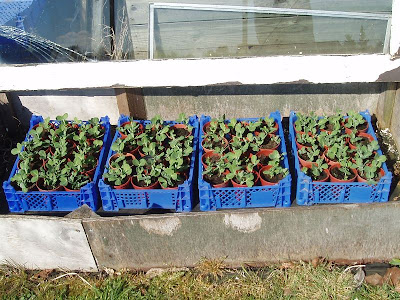
Early Peas
I sowed these in the greenhouse about three weeks ago. Today they're ready to go out in the coldframe to be hardened off for a week, next weekend I'll plant them out.

Sunday, 22 March 2009
Mothering
Apparently it's Mothering Sunday, so I've been round to the old gals for a bit of mothering but she was out, probably round at one me brothers or sisters giving them the mothering which is rightfully mine, me being the eldest and all. Anyway that's that for another year so we can talk about the weather.
The weather's been about six weeks in front of itself temperature-wise and yes global bloody capitalists I still blame you. A nice drop of rain is what we need now so if we're all very good and behave ourselves and try to think about something else then maybe it'll happen. Not that that ever works but you never know your luck.
It between not getting mothered I've been tarting up the old greenhouse and the coldframes, giving them a bit of mothering. Washing the glass and replacing the odd screw here and clip there. Not that I ever get any thanks.
I was going to do some sowing but now I'm putting it off till next weekend after reading an article telling me how the new moon in Aries will then be shining down benignly, no doubt in a mothering type of manner, and that'll be the ideal time according to this bloke here and who am I to argue. It's not like I write for the newspapers or anything. I wonder how he get's on with his mother. I bet she's well proud of him and goes round telling the neighbours what a bright boy he is writing for the newspapers and when he goes round she's always there with no end of mothering for him. What a gip.
The weather's been about six weeks in front of itself temperature-wise and yes global bloody capitalists I still blame you. A nice drop of rain is what we need now so if we're all very good and behave ourselves and try to think about something else then maybe it'll happen. Not that that ever works but you never know your luck.
It between not getting mothered I've been tarting up the old greenhouse and the coldframes, giving them a bit of mothering. Washing the glass and replacing the odd screw here and clip there. Not that I ever get any thanks.
I was going to do some sowing but now I'm putting it off till next weekend after reading an article telling me how the new moon in Aries will then be shining down benignly, no doubt in a mothering type of manner, and that'll be the ideal time according to this bloke here and who am I to argue. It's not like I write for the newspapers or anything. I wonder how he get's on with his mother. I bet she's well proud of him and goes round telling the neighbours what a bright boy he is writing for the newspapers and when he goes round she's always there with no end of mothering for him. What a gip.
Tuesday, 17 March 2009
More Raised Bed Nonsense - New And Improved!
I've been trying to get to the source of where this raised bed nonsense started and I think I may have found it:
Mel tells us he's not a horticulturalist, he's a civil engineer - he can build a box. Unfortunately for us he's also either a well-intentioned fool or a snake oil salesman. Going by the claims he makes I'd suggest the latter: he says compared with traditional methods his system uses 90% less water, 95% less seeds, will solve the world's hunger problems...no doubt it'll also give me a full head of hair and make me irresistible to women. He doesn't substantiate these claims, no doubt I'm supposed to buy the books and DVDs to find out - he must be one wealthy snake oil salesman judging by the amount he's managed to shift.
So you don't have to dig up your lawn - actually Mel that's exactly what you should be doing, even Michelle Obama's managed to figure that out. The soil is already there! You don't have to move it from A to B! You don't need to build boxes to put it in! This is not civil engineering!
Good grief Charlie Brown. Only in America.
Mel tells us he's not a horticulturalist, he's a civil engineer - he can build a box. Unfortunately for us he's also either a well-intentioned fool or a snake oil salesman. Going by the claims he makes I'd suggest the latter: he says compared with traditional methods his system uses 90% less water, 95% less seeds, will solve the world's hunger problems...no doubt it'll also give me a full head of hair and make me irresistible to women. He doesn't substantiate these claims, no doubt I'm supposed to buy the books and DVDs to find out - he must be one wealthy snake oil salesman judging by the amount he's managed to shift.
So you don't have to dig up your lawn - actually Mel that's exactly what you should be doing, even Michelle Obama's managed to figure that out. The soil is already there! You don't have to move it from A to B! You don't need to build boxes to put it in! This is not civil engineering!
Good grief Charlie Brown. Only in America.
Saturday, 14 March 2009
More Digging
Today I wanted to dig over the ground where my spuds will be going so I lifted the carrots which were in the way and put them to store in a box of sand. Some of them had gone a bit manky and needed to be chucked but must of them were still alright.
Because I was getting to the end of my usable compost I just spread it where the rows will be going and dug it in:


Because I was getting to the end of my usable compost I just spread it where the rows will be going and dug it in:


Storing Carrots

I stored my carrots in a box of kiln-dried sand left over from a landscaping job. Sharp (concreting) sand would be just as good. I rubbed the worst of the soil off them and cut off the foliage then put some sand in the bottom of a box and laid the carrots on top...

...then covered them with more sand...

...then added another layer and so on. Because I've got well-drained soil I leave my carrots in the ground over winter but if I were on wet ground I'd lift them all and store them this way in the autumn.
Debunking The Raised Bed Myth
Debunking The Raised Bed Myth: In Defence Of Traditional Organic Methods.
For some reason it seems to be the convention these days to advise new gardeners to grow their vegetables using raised beds and/or the no dig method. This has become the new orthodoxy. The media is teeming with adverts for raised bed kits and even the soil to fill them. (I wouldn't be surprised if there's one or two in the sidebar).
I was stirred to write this piece after reading a review of the Jon Jeavons book "How To Grow More Vegetables Than You Ever Thought Possible", in which the author advocates the use of the raised bed/no dig system, or as he names it (they always have a name), bio-intensive. The reviewer (the otherwise excellent Rob Hopkins) writes as follows:
"One of the great achievements of the book is how it highlights the absurdity of many gardening practices. On a conventional allotment, the whole thing is dug over, manured, and then rows are marked out, with the plants being planted in rows as the gardener walks up and down between the rows to look after them. Sounds logical in theory, and is has been the unchallenged orthodoxy for many years. But in practice, what is happening is that you are manuring the paths as much as the beds, digging the beds and then compacting the soil in them back down again, leaving space for weeds to grow in ground you have kindly manured for them, and basically creating several rods for your own back.
In the biointensive system, the raised beds are double dug, so as to maximise the depth of root penetration, and from that point forward, compost is only added onto the tops of the beds, which are never walked on. Most plants are started first in modules or in flat trays and then planted out into the beds on the tight spacings. This means that if you plant, say, lettuces, you may need to give a light weeding after a couple of weeks, but beyond that, they grow over and make a canopy, so there is no room for weeds to grow. Brilliant.
The successful application of the biointensive mode requires a lot of compost..."
I started gardening in the eighties, after the "Good Life" boom of the seventies had petered out (to be replaced by the rapaciousness of Thatcherism, but that's another story). Allotment sites were disappearing to development at a rate of knots. I was lucky enough to get a job with the Parks Department and a couple of years later acquired my first allotment. I learnt not so much from books but from watching and learning from the old timers on the site, all of whom had plots bursting with vegetables grown using traditional organic methods. Yes, manure was delivered to the site by the trailer load and dug in at the beginning of the season and yes, they chucked on growmore as well for good measure. (Though personally I've always used blood, fish and bone). After 25 years of putting into practice what I'd learnt I think I'm starting to get the hang of it, and I'm proud to say that each year I too now have a plot bursting with fresh produce.
As one of these "absurd" gardeners I'd like to make the case for these traditional methods. (Actually I like to think of myself as a "traditional organic" rather than a "conventional" or an "absurd" gardener).
To start with, this has been the orthodoxy for many years because, I presume, our ancestors spent hundreds of years figuring it out. I think it's worth paying them some heed. Unlike us urban dwellers they spent their whole lives on the land so it's not unreasonable to think that they knew a thing or two about what they were doing. So...
"On a conventional allotment, the whole thing is dug over, manured..." I think there's a good reason for this. On any garden the soil looks static but as we know it's teeming with life - earthworms, centipedes, right down to the microscopic level with all the bacteria and so on who are busy breaking down that manure or compost and distributing it throughout the soil. All that life is moving around, no doubt some of it from one end of the plot and back again during a season. Now imagine a forest on a hundred acres and all the diversity it contains. But in a forest of only ten or even fifty acres there will likely be less diversity. Now going back to our life in the soil I would like to postulate that THE MORE SPACE IT HAS TO MOVE AROUND IN THE MORE LIFE AND DIVERSITY THERE IS LIKELY TO BE. So it follows that if you divide your plot into narrow raised beds enclosed by boards the less beneficial life you will have in your soil. I'm not a scientist so I can't prove this, it just seems like common sense.
"In the biointensive system, the raised beds...are never walked on." I've worked in gardens with raised beds and unless they are waist high then it's extremely uncomfortable trying to work on them without walking on them, or at least putting your boot on them from time to time.
"Most plants are started first in modules or in flat trays and then planted out into the beds..." Nothing new there then.
"...on the tight spacings.This means that if you plant, say, lettuces, you may need to give a light weeding after a couple of weeks, but beyond that, they grow over and make a canopy, so there is no room for weeds to grow. Brilliant." Isn't it just. Nothing new there either. I'm starting to notice a pattern here. Except for the raised bed bit this is just the same as the traditional system.
"The successful application of the biointensive mode requires a lot of compost." As in the traditional method, where it's dug in. But this is different. Here you only dig once and then in the following years you add the compost from above. Whoopee! No more digging! Unfortunatly, leaving compost on top of the soil means you lose a lot of its goodness through oxidisation. (I too use compost as a mulch once plants are growing away nicely, if I can spare it, but this is in addition to, not a substitute for, incorparating it into the soil at the start of the season).
"Companion planting" Can't argue with that, but again it's hardly a new idea.
"...the plants being planted in rows..." This is just a matter of practicality. If I had an endless supply of time on my hands I might plant in wavy rows, it might even be more aesthetically pleasing to the eye, but it'd be a bugger to plan and work round.
"...as the gardener walks up and down between the rows to look after them...compacting the soil..." Wrong. When I've not long dug over my plot and I'm sowing in the spring when the soil is still damp I work off planks so as not to compact the soil. I then don't need to walk on it again (and wow betide anyone who does) until a few weeks later when I need to start weeding. By then the top of the soil has likely settled and dried out and isn't going to be compacted because I walk backwards with my dutch hoe loosening it up. And all that life is still going on its merry way beneath my feet. I end up with blocks of plants around four feet wide, for example if I've got three rows of french beans I can reach over with my hoe to weed between the rows until the gaps has closed up and shaded out most of the weeds.
The reviewer doesn't mention watering. Raising the soil a foot above the water table inevetably means lots of watering, especially around the edges near the boards where the soil will quickly dry out. Using traditional methods once I've watered in my plants or my seed drill I NEVER NEED TO WATER, except in extreme drought conditions. One of the prime reasons for digging in manure or compost is that it holds the moisture in the soil.
Pest control: Go outside and pick up a plank that's been lying on the ground. Clinging to the underneath will be lots of slugs and snails. Now see what you have where you've got planks of wood in contact with damp soil around a raised bed.
In the traditional system I rely on hedgehogs to take care of my slug and snail problem. Around two sides of my plot is a two metre strip of blackberries where they live and I often see them trolling their way around the place of a nighttime. Now, have you ever seen a hedgehog climb up a one foot plank onto a raised bed? I think not.
Another argument often given for the raised bed system is that they warm up quicker in the spring. I'm yet to be convinced that moving the soil a foot nearer the sun will achieve this. And even if it were true it hardly outweighs the disadvantages already outlined. On top of that you've got to spend hours constructing the darn things in the first place. Probably you'll want to use recycled timber but that will rot in a couple of years of being next to damp soil. So then you'll go out and buy some pressure-treated timber or scaffolding planks and try not to worry too much about how that'll affect your carbon footprint, or what damage those heavy metals from the treatment are doing leeching into your soil. Then you're going to have to move around vast amounts of soil to fill them up. You'll have to make paths between your beds which means slabs - a lot of slabs - or imported bark with dozens of metres of weed control fabric underneath it, or hours with the strimmer. Again, I'm not a scientist but it would be interesting if someone were to do a study of the time/reward ratio of all this compared to two or three days digging once a year.
For me raised bed gardening just seems like an unnecessary complication. What's wrong with "There's the ground - go work it"? But that would be absurd. Wouldn't it?
Simon 14.3.09
This article is open source, not copyrighted, feel free to spread it around. Hopefully it might be catching. And when you're done, don't forget to compost it.
For some reason it seems to be the convention these days to advise new gardeners to grow their vegetables using raised beds and/or the no dig method. This has become the new orthodoxy. The media is teeming with adverts for raised bed kits and even the soil to fill them. (I wouldn't be surprised if there's one or two in the sidebar).
I was stirred to write this piece after reading a review of the Jon Jeavons book "How To Grow More Vegetables Than You Ever Thought Possible", in which the author advocates the use of the raised bed/no dig system, or as he names it (they always have a name), bio-intensive. The reviewer (the otherwise excellent Rob Hopkins) writes as follows:
"One of the great achievements of the book is how it highlights the absurdity of many gardening practices. On a conventional allotment, the whole thing is dug over, manured, and then rows are marked out, with the plants being planted in rows as the gardener walks up and down between the rows to look after them. Sounds logical in theory, and is has been the unchallenged orthodoxy for many years. But in practice, what is happening is that you are manuring the paths as much as the beds, digging the beds and then compacting the soil in them back down again, leaving space for weeds to grow in ground you have kindly manured for them, and basically creating several rods for your own back.
In the biointensive system, the raised beds are double dug, so as to maximise the depth of root penetration, and from that point forward, compost is only added onto the tops of the beds, which are never walked on. Most plants are started first in modules or in flat trays and then planted out into the beds on the tight spacings. This means that if you plant, say, lettuces, you may need to give a light weeding after a couple of weeks, but beyond that, they grow over and make a canopy, so there is no room for weeds to grow. Brilliant.
The successful application of the biointensive mode requires a lot of compost..."
I started gardening in the eighties, after the "Good Life" boom of the seventies had petered out (to be replaced by the rapaciousness of Thatcherism, but that's another story). Allotment sites were disappearing to development at a rate of knots. I was lucky enough to get a job with the Parks Department and a couple of years later acquired my first allotment. I learnt not so much from books but from watching and learning from the old timers on the site, all of whom had plots bursting with vegetables grown using traditional organic methods. Yes, manure was delivered to the site by the trailer load and dug in at the beginning of the season and yes, they chucked on growmore as well for good measure. (Though personally I've always used blood, fish and bone). After 25 years of putting into practice what I'd learnt I think I'm starting to get the hang of it, and I'm proud to say that each year I too now have a plot bursting with fresh produce.
As one of these "absurd" gardeners I'd like to make the case for these traditional methods. (Actually I like to think of myself as a "traditional organic" rather than a "conventional" or an "absurd" gardener).
To start with, this has been the orthodoxy for many years because, I presume, our ancestors spent hundreds of years figuring it out. I think it's worth paying them some heed. Unlike us urban dwellers they spent their whole lives on the land so it's not unreasonable to think that they knew a thing or two about what they were doing. So...
"On a conventional allotment, the whole thing is dug over, manured..." I think there's a good reason for this. On any garden the soil looks static but as we know it's teeming with life - earthworms, centipedes, right down to the microscopic level with all the bacteria and so on who are busy breaking down that manure or compost and distributing it throughout the soil. All that life is moving around, no doubt some of it from one end of the plot and back again during a season. Now imagine a forest on a hundred acres and all the diversity it contains. But in a forest of only ten or even fifty acres there will likely be less diversity. Now going back to our life in the soil I would like to postulate that THE MORE SPACE IT HAS TO MOVE AROUND IN THE MORE LIFE AND DIVERSITY THERE IS LIKELY TO BE. So it follows that if you divide your plot into narrow raised beds enclosed by boards the less beneficial life you will have in your soil. I'm not a scientist so I can't prove this, it just seems like common sense.
"In the biointensive system, the raised beds...are never walked on." I've worked in gardens with raised beds and unless they are waist high then it's extremely uncomfortable trying to work on them without walking on them, or at least putting your boot on them from time to time.
"Most plants are started first in modules or in flat trays and then planted out into the beds..." Nothing new there then.
"...on the tight spacings.This means that if you plant, say, lettuces, you may need to give a light weeding after a couple of weeks, but beyond that, they grow over and make a canopy, so there is no room for weeds to grow. Brilliant." Isn't it just. Nothing new there either. I'm starting to notice a pattern here. Except for the raised bed bit this is just the same as the traditional system.
"The successful application of the biointensive mode requires a lot of compost." As in the traditional method, where it's dug in. But this is different. Here you only dig once and then in the following years you add the compost from above. Whoopee! No more digging! Unfortunatly, leaving compost on top of the soil means you lose a lot of its goodness through oxidisation. (I too use compost as a mulch once plants are growing away nicely, if I can spare it, but this is in addition to, not a substitute for, incorparating it into the soil at the start of the season).
"Companion planting" Can't argue with that, but again it's hardly a new idea.
"...the plants being planted in rows..." This is just a matter of practicality. If I had an endless supply of time on my hands I might plant in wavy rows, it might even be more aesthetically pleasing to the eye, but it'd be a bugger to plan and work round.
"...as the gardener walks up and down between the rows to look after them...compacting the soil..." Wrong. When I've not long dug over my plot and I'm sowing in the spring when the soil is still damp I work off planks so as not to compact the soil. I then don't need to walk on it again (and wow betide anyone who does) until a few weeks later when I need to start weeding. By then the top of the soil has likely settled and dried out and isn't going to be compacted because I walk backwards with my dutch hoe loosening it up. And all that life is still going on its merry way beneath my feet. I end up with blocks of plants around four feet wide, for example if I've got three rows of french beans I can reach over with my hoe to weed between the rows until the gaps has closed up and shaded out most of the weeds.
The reviewer doesn't mention watering. Raising the soil a foot above the water table inevetably means lots of watering, especially around the edges near the boards where the soil will quickly dry out. Using traditional methods once I've watered in my plants or my seed drill I NEVER NEED TO WATER, except in extreme drought conditions. One of the prime reasons for digging in manure or compost is that it holds the moisture in the soil.
Pest control: Go outside and pick up a plank that's been lying on the ground. Clinging to the underneath will be lots of slugs and snails. Now see what you have where you've got planks of wood in contact with damp soil around a raised bed.
In the traditional system I rely on hedgehogs to take care of my slug and snail problem. Around two sides of my plot is a two metre strip of blackberries where they live and I often see them trolling their way around the place of a nighttime. Now, have you ever seen a hedgehog climb up a one foot plank onto a raised bed? I think not.
Another argument often given for the raised bed system is that they warm up quicker in the spring. I'm yet to be convinced that moving the soil a foot nearer the sun will achieve this. And even if it were true it hardly outweighs the disadvantages already outlined. On top of that you've got to spend hours constructing the darn things in the first place. Probably you'll want to use recycled timber but that will rot in a couple of years of being next to damp soil. So then you'll go out and buy some pressure-treated timber or scaffolding planks and try not to worry too much about how that'll affect your carbon footprint, or what damage those heavy metals from the treatment are doing leeching into your soil. Then you're going to have to move around vast amounts of soil to fill them up. You'll have to make paths between your beds which means slabs - a lot of slabs - or imported bark with dozens of metres of weed control fabric underneath it, or hours with the strimmer. Again, I'm not a scientist but it would be interesting if someone were to do a study of the time/reward ratio of all this compared to two or three days digging once a year.
For me raised bed gardening just seems like an unnecessary complication. What's wrong with "There's the ground - go work it"? But that would be absurd. Wouldn't it?
Simon 14.3.09
This article is open source, not copyrighted, feel free to spread it around. Hopefully it might be catching. And when you're done, don't forget to compost it.
Subscribe to:
Posts (Atom)